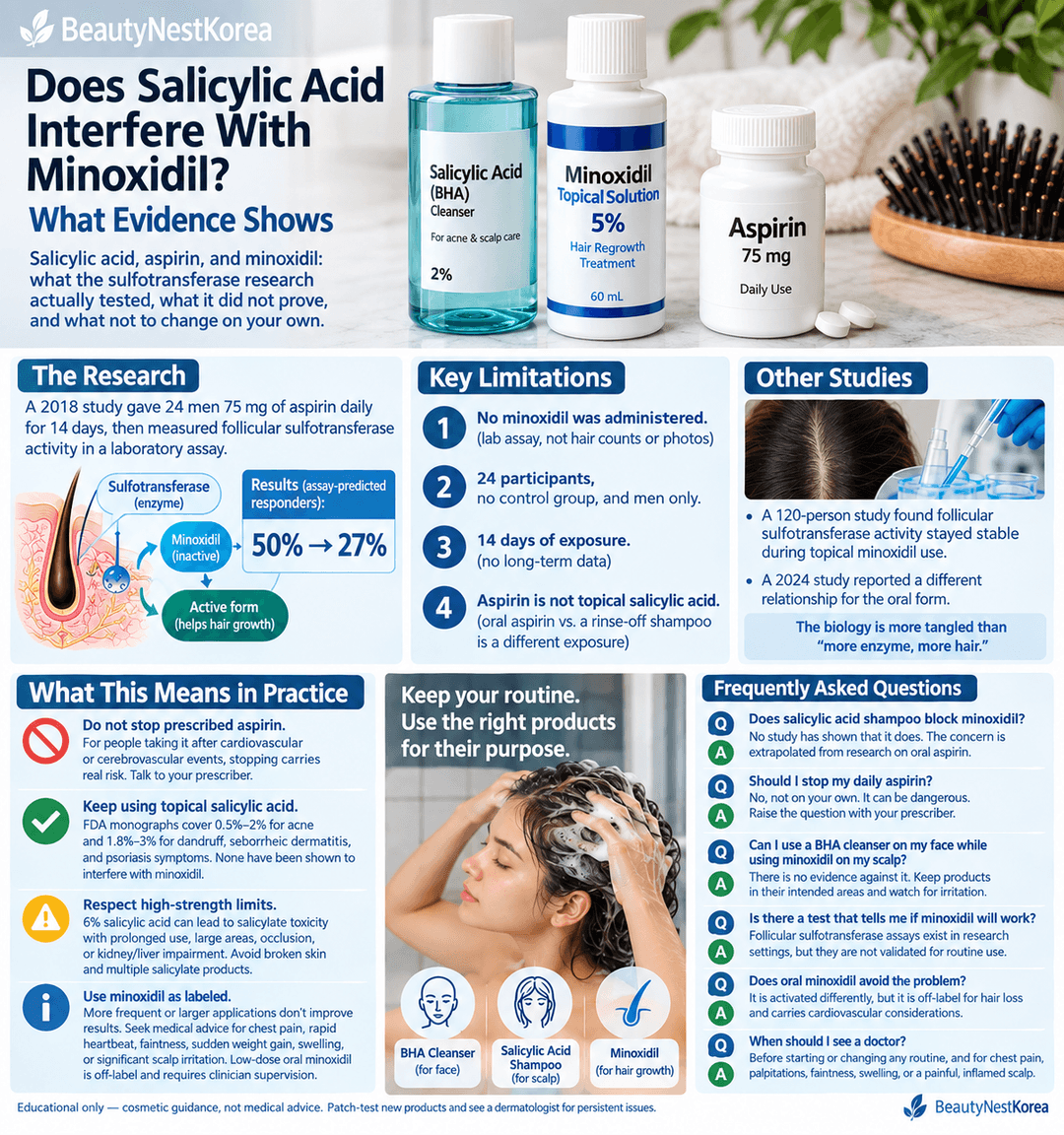
Salicylic acid, aspirin, and minoxidil: what the sulfotransferase research actually tested, what it did not prove, and what not to change on your own.
Our picks are cosmetic product recommendations, not medical prescriptions. Some links are affiliate links — we may earn a commission at no extra cost to you.
Educational only — cosmetic guidance and product curation, not medical advice. Patch-test new products and see a dermatologist for persistent issues.
By BeautyNestKorea Editorial Team Published: 2026-09-20 · Last updated: 2026-09-20 Researched from FDA labeling and peer-reviewed sources. Not medically reviewed.
Educational only. This page explains published research. It is not medical advice and not a recommendation to start, stop, or change any medication. Never stop a prescribed medication based on an article. Talk to the clinician who prescribed it.
A claim circulates in hair-loss forums: salicylic acid blocks minoxidil, so your BHA cleanser or dandruff shampoo is quietly wasting your routine. The claim traces back to a real study, but that study did not test what people think it tested.
The Short Answer
There is no clinical evidence that ordinary topical salicylic acid, such as a face cleanser or a rinse-off scalp shampoo, reduces how well topical minoxidil works. There is also no evidence that it helps. The interaction is a hypothesis, not a finding.
What the Research Actually Tested
Minoxidil is a prodrug: an enzyme called sulfotransferase converts it into its active form, and follicular sulfotransferase activity has been associated with how well people respond to the topical version.
A 2018 study of 24 men with androgenetic alopecia gave participants 75 mg of aspirin daily for 14 days, then measured follicular sulfotransferase activity in a laboratory assay. Assay-predicted responders fell from 50% to 27%.
Four limitations matter more than that headline number:
- No minoxidil was administered. The endpoint was a lab assay, not hair counts, photographs, or patient-reported regrowth.
- 24 participants, no control group, and men only.
- 14 days of exposure. Nothing about whether an effect persists.
- Aspirin is not topical salicylic acid. Oral aspirin is absorbed systemically and metabolized to salicylate; a rinse-off shampoo is not the same exposure.
Separately, a 120-person study found follicular sulfotransferase activity stayed stable during topical minoxidil use, and a 2024 study reported a different relationship for the oral form. The biology is more tangled than "more enzyme, more hair."
What This Means in Practice
Do not stop prescribed aspirin to improve hair growth. For people taking it after cardiovascular or cerebrovascular events, stopping carries real risk that dwarfs a hypothetical enzyme effect. That decision belongs to your prescriber.
Keep using topical salicylic acid for what it is labeled for. FDA monographs cover it at 0.5% to 2% for acne and 1.8% to 3% for dandruff, seborrheic dermatitis, and psoriasis symptoms. None of those are hair-growth indications, and none of them have been shown to interfere with minoxidil.
Respect high-strength limits. Labels for 6% salicylic acid warn that prolonged use over large areas, under occlusion, or in people with kidney or liver impairment can lead to salicylate toxicity. Avoid broken or inflamed skin, and avoid layering multiple salicylate products.
Use minoxidil as labeled. More frequent or larger applications do not improve results, and the label directs you to seek medical advice for chest pain, rapid heartbeat, faintness, sudden weight gain, swelling, or significant scalp irritation. Low-dose oral minoxidil for hair loss is off-label and is not something to self-start.
Frequently Asked Questions
Does salicylic acid shampoo block minoxidil? No study has shown that it does. The concern is extrapolated from research on oral aspirin, which is a different exposure route and a different dose.
Should I stop my daily aspirin so minoxidil works better? No, not on your own. Low-dose aspirin is often prescribed for cardiovascular protection, and stopping it can be dangerous. Raise the question with your prescriber instead.
Can I use a BHA cleanser on my face while using minoxidil on my scalp? There is no evidence against it. Keep the products to their intended areas and watch for scalp irritation, which is a reason to reassess regardless of any enzyme theory.
Is there a test that tells me if minoxidil will work for me? Follicular sulfotransferase assays exist in research settings, but they are not validated well enough to guide routine consumer decisions. Treat marketing that promises otherwise with suspicion.
Does oral minoxidil avoid the problem? Oral minoxidil is activated differently, but it is off-label for hair loss and carries cardiovascular considerations. It requires clinician supervision, not a workaround decision.
When should I see a doctor? See one before starting or changing any minoxidil routine, and promptly for chest pain, palpitations, faintness, sudden swelling or weight gain, or a painful, inflamed scalp.
Sources
- PubMed: Low-dose daily aspirin reduces topical minoxidil efficacy in androgenetic alopecia patients
- DailyMed: Minoxidil 5% topical solution label
- FDA: Salicylic acid, OTC acne, 21 CFR 333.310
- FDA: Salicylic acid, dandruff and seborrheic dermatitis, 21 CFR 358.710
- PubMed: Follicular sulfotransferase activity during topical minoxidil use
Educational only. Not medical advice. Do not start, stop, or change any medication based on this page.