Not every dark mark is a scar. The 30-second guide to telling scars from hyperpigmentation.
Our picks are cosmetic product recommendations, not medical prescriptions. Some links are affiliate links — we may earn a commission at no extra cost to you.
Educational only — cosmetic guidance and product curation, not medical advice. Patch-test new products and see a dermatologist for persistent issues.
⚕️ A Note on Skin Health
BeautyNestKorea is an independent skincare and beauty publication dedicated to evidence-informed education, product research, and practical skincare guidance.
Our articles are created to help you better understand your skin and the science behind skincare ingredients and treatments. They are for educational purposes only and should not be considered a diagnosis, personalized medical advice, or a substitute for professional care.
Skin responds differently from person to person. Research findings and skincare results can vary depending on individual skin type, condition, sensitivity, and other factors. When we discuss treatments or professional procedures, we aim to explain the available evidence and realistic expectations—not prescribe a treatment plan.
If you have a persistent, painful, rapidly changing, or concerning skin issue, or if you are unsure which treatment is appropriate for you, please consult a qualified dermatologist or healthcare professional.
Product recommendations on BeautyNestKorea are cosmetic suggestions, not medical treatments. Where applicable, some links may be affiliate links, meaning we may earn a commission at no additional cost to you. Our editorial recommendations remain independent of these relationships.
By Mohamed Mosbeh · Founder & Beauty Curator, BeautyNestKorea Published: 2026-09-14 · Last updated: 2026-09-14 Mohamed Mosbeh founded BeautyNestKorea to bring transparent, per-ml price comparisons and evidence-based K-beauty guidance to shoppers.
🎯 The 30-Second Answer
Is your mark smooth and flat? → It's hyperpigmentation (PIH). Good news: it often fades with sunscreen + time + the right serum.
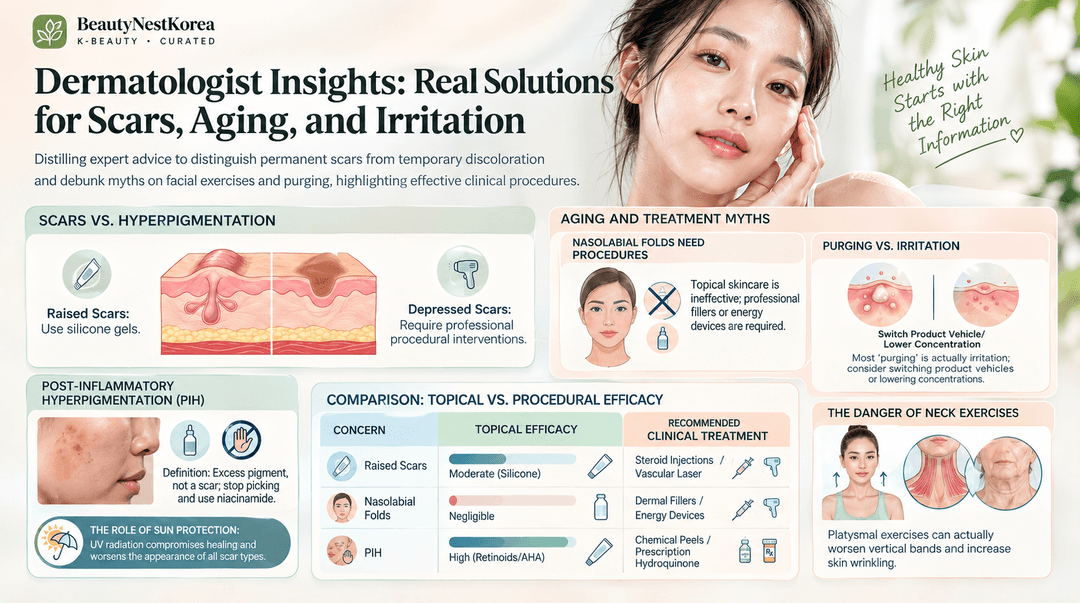
Is it indented or raised? → It's a scar. Hard truth: no cream fills a scar. Silicone helps raised ones slightly; depressed scars need a dermatologist (microneedling/laser).
The one rule that matters most: Wear sunscreen every single day. Without it, nothing else works.
→ Jump to: The Quick Test · What Should I Do? · My Routine
🔍 The 10-Second Test: Scar or Dark Spot?
- Run your finger over the mark. Smooth = pigment. Bumpy or indented = scar.
- Look in side light (phone flashlight from the side). Casts a shadow = scar.
- Press gently. Fades white then returns = red mark (PIE). Stays brown = PIH.
That's it. You now know which path to take. 👇
🧭 What Should I Do?
| Your concern | At-home care | See a dermatologist when |
|---|---|---|
| Flat brown spot (PIH) | Daily SPF + Niacinamide or Azelaic Acid + patience (3–6 months) | No improvement after ~12 months |
| Red/pink mark (PIE) | Soothing care + Niacinamide + daily SPF | Persistent — vascular laser (PDL/IPL) helps |
| Raised scar | Silicone gel/sheet daily for 3–6 months (modest benefit) | Itchy/growing/keloid — steroid injections or laser |
| Indented scar | Creams can't fill it ❌ (retinoids only soften texture slightly) | Microneedling / laser / filler / subcision |
A Simple Routine
Morning: Gentle cleanser → one active (Vitamin C or Niacinamide or Azelaic Acid) → moisturiser → broad-spectrum SPF 30+ (tinted/iron-oxide if you have a deeper skin tone ).
Evening: Cleanser → one active (a retinoid or Azelaic Acid — not both when starting) → moisturiser.
Start any new active 2–3 nights/week and build up slowly. In skin of colour, irritation itself triggers new pigment — so slow beats strong. Browse our Sunscreen edit and Serum collection for supportive picks (cosmetic, not medical).
─── Want the deeper science? Keep reading ───
📖 The full evidence-based breakdown (click to expand)
The Core Difference — Structure vs Pigment
A scar is damaged collagen rebuilt imperfectly — too much (raised) or too little (depressed). You can feel it; it casts a shadow. Hyperpigmentation leaves the surface intact — only melanin changes. It's flat and smooth. That's why the finger-and-side-light test works.
Raised vs Depressed Scars
Hypertrophic scars stay within the wound border; keloids grow beyond it and recur easily. Silicone gel/sheets may slightly soften raised scars, but Cochrane rates the evidence low-to-very-low certainty — and silicone does nothing for depressed scars. Depressed scars (rolling, boxcar, ice-pick ) need procedures: microneedling has the best evidence as monotherapy, plus fractional lasers, subcision, fillers, and TCA CROSS. All carry risks — including new PIH in darker skin.
Post-Inflammatory Hyperpigmentation (PIH)
Excess pigment after inflammation — acne, eczema, friction. Most persistent in melanin-rich skin. Step one: stop picking. Evidence-backed topicals: retinoids (tretinoin/adapalene/trifarotene); azelaic acid 15–20% (try our Anua Azelaic Acid 10 serum); niacinamide 4–5%; vitamin C 10–20%; tranexamic acid 3–5%. Hydroquinone is potent but risks permanent ochronosis — medical supervision only.
PIE vs PIH: press the mark — blanches white = PIE (vascular); stays = PIH (pigment). PIE needs soothing + vascular lasers; PIH needs pigment actives + SPF.
Sunscreen Is Non-Negotiable
UV darkens pigment and slows fading. Crucially, in deeper skin tones visible light also drives long-lasting pigment — tinted/iron-oxide sunscreens protect meaningfully better than untinted. SPF doesn't "heal" scars; it prevents worsening so everything else can work.
Purging vs Irritation
"Purging" is overused. True purging (faster surfacing of existing microcomedones) peaks in 2–6 weeks in usual breakout zones. Most "purging" is actually irritation — stinging, diffuse redness, new-area bumps. If it stings week after week, slow down — don't push through. The AAD advises starting retinoids low and slow, especially in skin of colour.
Nasolabial Folds & Deep Wrinkles
Topicals cannot lift or fill a nasolabial fold — it's driven by volume loss. Moisturisers plump temporarily; retinoids improve fine surface texture only. Real change is procedural (fillers, RF/ultrasound, resurfacing) — legitimate, but medical decisions, not skincare upgrades.
Facial & Neck Exercises
Evidence is thin and mixed. Small studies suggest possible modest cheek fullness, but systematic reviews find insufficient evidence for rejuvenation. Repetitive platysma contraction could theoretically deepen lines. Low-risk for most, but not an evidence-based anti-ageing treatment — don't swap it for sunscreen and proven care.
Topical vs Professional — Full Table
| Concern | At-home | Professional | Limitations |
|---|---|---|---|
| PIH | SPF, retinoids, azelaic, niacinamide, vit C, TXA | Peels, lasers, Rx combos | Months needed; peels risk rebound PIH in dark skin |
| PIE | Soothing, niacinamide | PDL, IPL | Topicals limited on vascular marks |
| Raised scars | Silicone (modest) | Steroid injections, laser | Topicals won't remove; keloids recur |
| Depressed scars | Retinoids (mild) | Microneedling, laser, subcision, filler | Creams can't fill tissue loss |
| Melasma | Tinted SPF, azelaic, TXA; HQ under care only | Lasers (cautious), peels | Chronic/relapsing; heat & visible light trigger |
Where Korean Skincare Fits
K-beauty's strength is a gentle, consistent, barrier-first routine with diligent SPF — exactly what evidence supports for pigment care. Hydration + ceramides support a resilient barrier, which helps keep irritation — and the pigment that can follow it — from taking hold; elegant high-SPF (incl. tinted) tackles the #1 factor; introducing one active at a time mirrors "start low and slow". But no essence fills an ice-pick scar or lifts a fold. K-beauty builds the calm, protected canvas where pigment fades and procedures recover faster. See our SKIN1004 Hyalu-Cica Sun Serum, acne care, and brightening picks.
When to See a Dermatologist
Book a pro for: rapidly changing marks; painful/itchy/growing raised scars or keloids; severe/cystic acne that's scarring; pigment persisting 6–12 months despite good care; suspected melasma; signs of infection; or anything that worries you.
💡 Key Takeaways
- Scars = structural; hyperpigmentation = pigment. Smooth/flat = pigment; textured/indented = scar.
- PIH isn't a scar — excess melanin that often fades with SPF + time + right actives.
- PIE (red) ≠ PIH (brown) — the blanch test tells them apart.
- Sunscreen is non-negotiable — tinted/iron-oxide matters for deeper skin (visible light drives pigment).
- Topicals can't fill depressed scars or lift deep folds — those need procedures.
- "Purging" is often irritation — persistent sting means slow down.
- Facial exercises lack strong evidence — not a substitute for SPF + proven care.
- Hydroquinone is powerful but risky — medical supervision only.
❓ Frequently Asked Questions
How do I tell a scar from hyperpigmentation? Finger + side light: smooth/flat = PIH; indented/raised = scar.
Will hyperpigmentation fade on its own? Epidermal PIH often fades over months with SPF; dermal pigment takes longer.
Does vitamin C lighten dark spots? L-ascorbic acid 10–20% has clinical support, but stability matters.
Is azelaic acid safe for darker skin? Yes — generally well tolerated in deeper tones, and commonly chosen for brightening uneven tone and supporting blemish-prone skin.
Breakouts after retinol — purging? Maybe if in usual zones and settling in weeks. Persistent sting/redness = irritation — slow down.
Can a cream fill indented scars? No. Retinoids mildly improve texture; real correction needs procedures.
Do facial exercises reverse ageing? Limited, mixed evidence — insufficient to confirm benefits.
When should I see a dermatologist? Changing, painful, severe, keloid-like, or >6–12 months persistent — book a consult.
References (selected)
American Academy of Dermatology — acne scars; Reynolds RV et al., JAAD 2024; Auffret N, Acta Derm Venereol 2025; Mar K et al., JCAD 2024; Callender VD, PMC 2021; Cochrane — silicone gel sheeting 2021; Sauer N, PMC 2024; Albzea W, PMC 2023; Navarrete-Solís J, PMC 2011; He X et al., PMC 2023; Lim HW, JID 2021; Zhou C, JAAD 2023; Alam M et al., JAMA Derm 2018; Manincor EO, systematic review 2024; El-Domyati M, PMC 2015; Sitohang IBS, 2021; Schwartz C, StatPearls 2023; Bae-Harboe YSC, PMC 2013.