Every sunscreen aisle gets argued about in the same two words: chemical or mineral. The split is real, but it is the least useful way to choose a bottle. What actually decides how a sunscreen protects you — and whether you will keep using it — is which filter family is inside, how those filters work together, and how much of it ends up on your skin. This guide walks through the three filter families, a real hybrid label, and the checklist that matters at the shelf.
Why "chemical vs mineral" is the wrong way to read a label
"Chemical" sounds harsh, "mineral" sounds natural and safe. Neither word matches how the science reads. Every UV filter, zinc oxide included, works through chemistry — and "mineral" only tells you where the filter sits: inorganic particles that stay on the skin's surface, versus organic molecules that absorb UV energy and release it as heat.
Three narrower questions do the real work:
- Which wavelengths does this bottle cover? UVB (burning) only, or UVA (aging) too?
- Is the filter system stable in sunlight? Some filters break down within hours unless they are paired with stabilisers.
- Does the texture suit your skin? A perfect filter list means nothing if the finish is so heavy you skip the second layer.
The three filter families and what each one actually blocks
| Family | Common filters | What it covers | Typical profile |
|---|---|---|---|
| Mineral (inorganic) | Zinc oxide, titanium dioxide | Zinc: UVB + most of UVA. Titanium: mostly UVB | Photostable and gentle; higher percentages can leave a cast |
| Chemical (organic) | Avobenzone, octinoxate, octisalate, octocrylene | Each covers a slice of UVB/UVA; blends cover both | Lightweight and elegant; some need stabilising partners |
| Hybrid | One mineral + one or more organic filters | Broad when the pairing is balanced | Protection close to mineral, texture close to organic |
Mineral filters: zinc oxide and titanium dioxide
These sit on the surface and handle UV across their range — zinc oxide covers UVB and most of UVA in one ingredient, while titanium dioxide is mainly a UVB worker, so formulators usually pair it with something that fills the UVA gap. Because they do not break down in sunlight and rarely sting, mineral filters are the usual first pick for reactive or freshly treated skin. The trade-off is optical: the same particles that reflect UV also reflect visible light, which is what shows up as white cast — more noticeable the higher the percentage and the deeper the skin tone.
Chemical filters: the lightweight family
Organic filters absorb UV radiation and convert it to heat energy before it can reach the skin. Each molecule handles a different band — octinoxate is a strong UVB absorber, avobenzone covers the long UVA range, octisalate sits in between — which is why real formulas are always blends rather than single filters. The advantage is cosmetic: chemical filters dissolve into the formula, so the finish disappears on every skin tone and plays well under makeup. The caveats are the ones you have already met: some need stabilising partners to survive a few hours of sun, and a small number of skins react to them, usually around the eyes.
Why "hybrid" is the honest middle word
A hybrid simply pairs one mineral filter with one or more chemical filters so each covers the other's gap. The mineral anchor contributes broad, photostable coverage; the chemical partner lifts the SPF number and keeps the texture light. "Hybrid" is not a marketing invention — it is the accurate description of most modern daily sunscreens, including several on this site's shelf.
What "hybrid" means — a real label example
The clearest example is EltaMD UV Daily Broad-Spectrum SPF 40, whose active-ingredient panel reads:
- Zinc Oxide 9.0% — the mineral filter, covering UVB and most of UVA.
- Octinoxate 7.5% — the chemical filter, reinforcing UVB to reach SPF 40 while keeping the texture spreadable.
Neither ingredient alone would give that exact balance: pure zinc at 9% is gentler but heavier and more cast-prone; octinoxate alone is light but leaves the UVA side less covered. Together they are a hybrid, and the label tells you so in the ingredient list — no special badge required. If you want the full breakdown of that specific bottle, our EltaMD UV Daily review walks through the same label line by line.
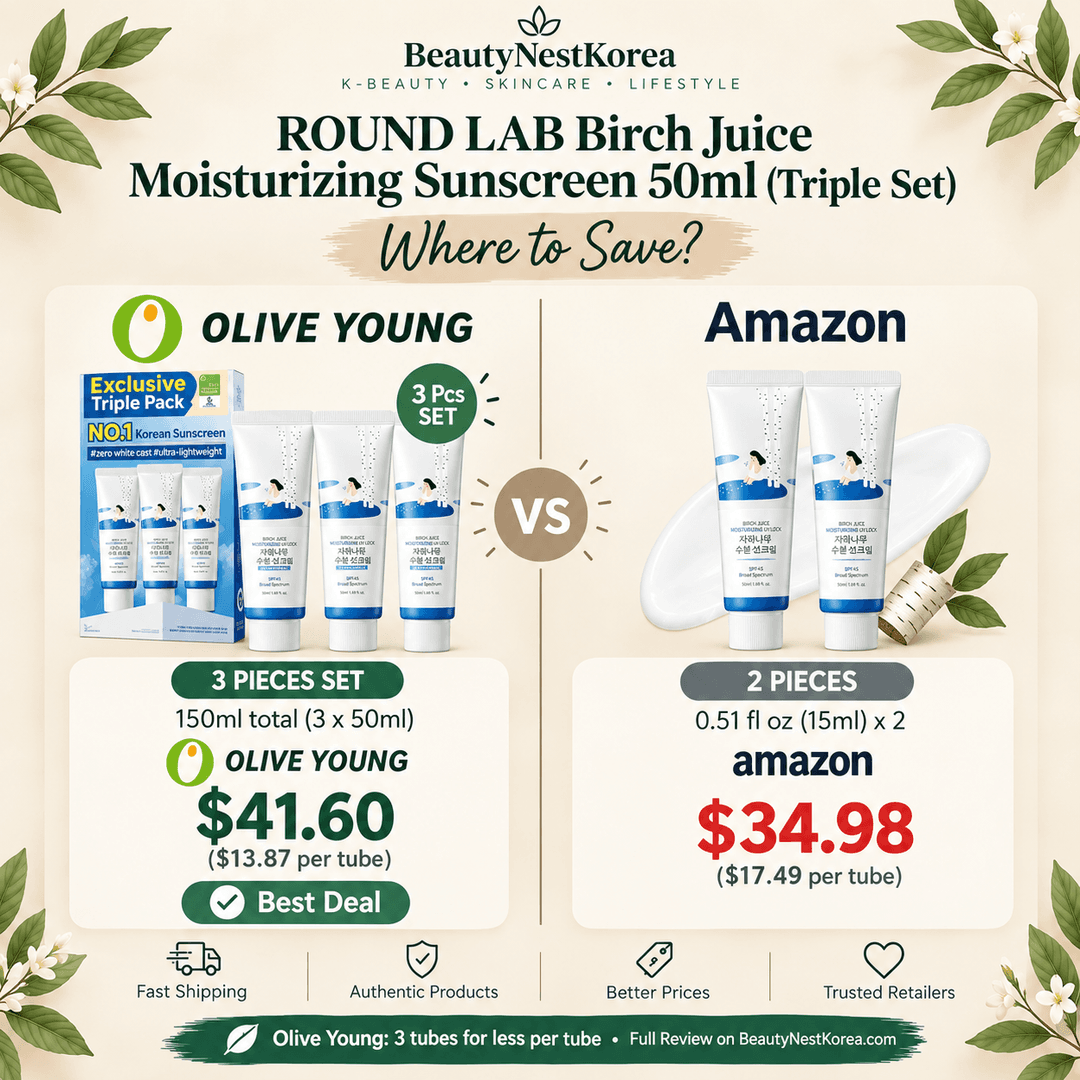
One caveat worth knowing: reformulations are real. The US "UV Lock" version of ROUND LAB Birch Juice is reformulated to meet US OTC sunscreen regulations, so its filter blend differs slightly from the original Korean version — the family and the finish stay the same, but the exact list on the box changes by market. Read the panel in front of you, not the one you saw in a review from another country.
White cast, irritation, skin tone: which filters to prefer
- Deep skin tones or anyone who dislikes cast: a hybrid or a well-formulated chemical sunscreen disappears fastest. If you do want mineral, look for micronised zinc or a tinted version — the tint does the same job white particles do, but for visible light instead of against it.
- Reactive, freshly exfoliated or procedure-treated skin: mineral sits on the surface and does not absorb, so it is the conventional default. That said, irritation usually comes from fragrance, alcohol or preservatives in the base rather than from the filter itself — check the inactive list before blaming "chemical sunscreens" as a class.
- Around the eyes and during sport: chemical filters are more often the ones that sting when sweat carries them down. A mineral stick along the orbital bone is the standard workaround.
- Oily or acne-prone skin: filter choice matters less than the base — "oil-free" and gel or fluid textures decide comfort far more than mineral-versus-chemical does.
No family blocks everything perfectly, and no family is dangerous at approved concentrations. The best filter type is still the one you will apply without hesitation every single morning.
How much to apply (2 mg/cm²) — why a perfect formula still fails
Every SPF number on every bottle is measured in a lab at 2 mg per square centimetre of skin. Independent application studies keep finding the same thing: real people apply roughly half to a quarter of that amount — and SPF scales with quantity. A generously applied SPF 30 behaves like an SPF 30; the same product dabbed on thinly can perform closer to an SPF 10–15 in practice.
Practical translation for the face:
- Two fingers of product (index and middle finger, end to end) is the standard face-and-neck dose.
- Apply 15 minutes before sun exposure so the film sets.
- Reapply every two hours in continuous sun — more often after swimming, sweating or towelling. Water-resistant ratings on labels describe how long a measured SPF holds up in water, not how long it lasts on land.
- Moisturiser with SPF 15 is not a substitute for a dedicated sunscreen layer in the morning, and no sunscreen is "all-day" without reapplication.
Label checklist (SPF · broad spectrum · water resistance)
Before buying, three lines on the back do most of the screening:
- SPF 30 or higher. SPF 30 blocks roughly 97% of UVB; SPF 50 blocks about 98%. Beyond that, the gains are small — quantity and reapplication matter more.
- "Broad spectrum." This is the regulated phrase meaning the product is tested across UVA and UVB. Without it, a high SPF number only covers burning.
- Water resistance: 40 or 80 minutes. Both are lab-tested durations; "waterproof" is not a permitted claim in several markets and no sunscreen is sweatproof in any practical sense.
On the Korean side of the shelf you will also see PA++++ (a UVA grading scale, with four pluses the highest) and SPF50+. PA ratings tell the same story as "broad spectrum" from a different regulatory tradition — useful, not contradictory.
FAQ
Is a hybrid sunscreen safer than a chemical one?
Neither is inherently safer at approved use levels. Hybrid formulas let you use a lower total load of any single filter while keeping the SPF and texture, which is why formulators like them — but "safe" is decided by the full formula and its testing, not by the family label.
Do I still need sunscreen if my foundation has SPF?
Only if you apply foundation the way the SPF was tested — 2 mg/cm². Most people apply a fraction of that amount of foundation, so treat any makeup SPF as a bonus layer, not your daily protection.
Which sunscreen is better for dark skin tones?
Whichever leaves no cast and feels good enough to reapply — usually a hybrid, chemical, or tinted mineral formula. The filter family is secondary to finishing; that is what determines daily use.
Does a chemical sunscreen stop working after two hours?
The filters do not stop, but some do photodegrade over time — which is exactly why the two-hour reapplication rule applies to every family, mineral included. The rule compensates for sun exposure, rubbing and sweating more than for chemical breakdown.
What is the difference between PA++++ and broad spectrum?
Both address UVA coverage. "Broad spectrum" is the US FDA test standard; PA++++ is the Japanese/Korean PPD scale and represents the top tier of that scale. A K-beauty SPF50+ PA++++ and a US broad-spectrum SPF 50 are making the same claim in two systems.
Sources
- US FDA — Sunscreen: How to help protect your skin from the sun
- DailyMed (US National Library of Medicine) — EltaMD UV Daily active-ingredient panel
- Product facts as published on each linked product page (see Recommended Products below)
BeautyNestKorea is an editorial site: product links may be affiliate links, which do not affect our recommendations. This article is educational and is not medical advice.
.png&w=1080&q=75)